
Coconut Shell vs. Fruitwood Quick-Light Hookah Charcoal: A Sourcing Guide

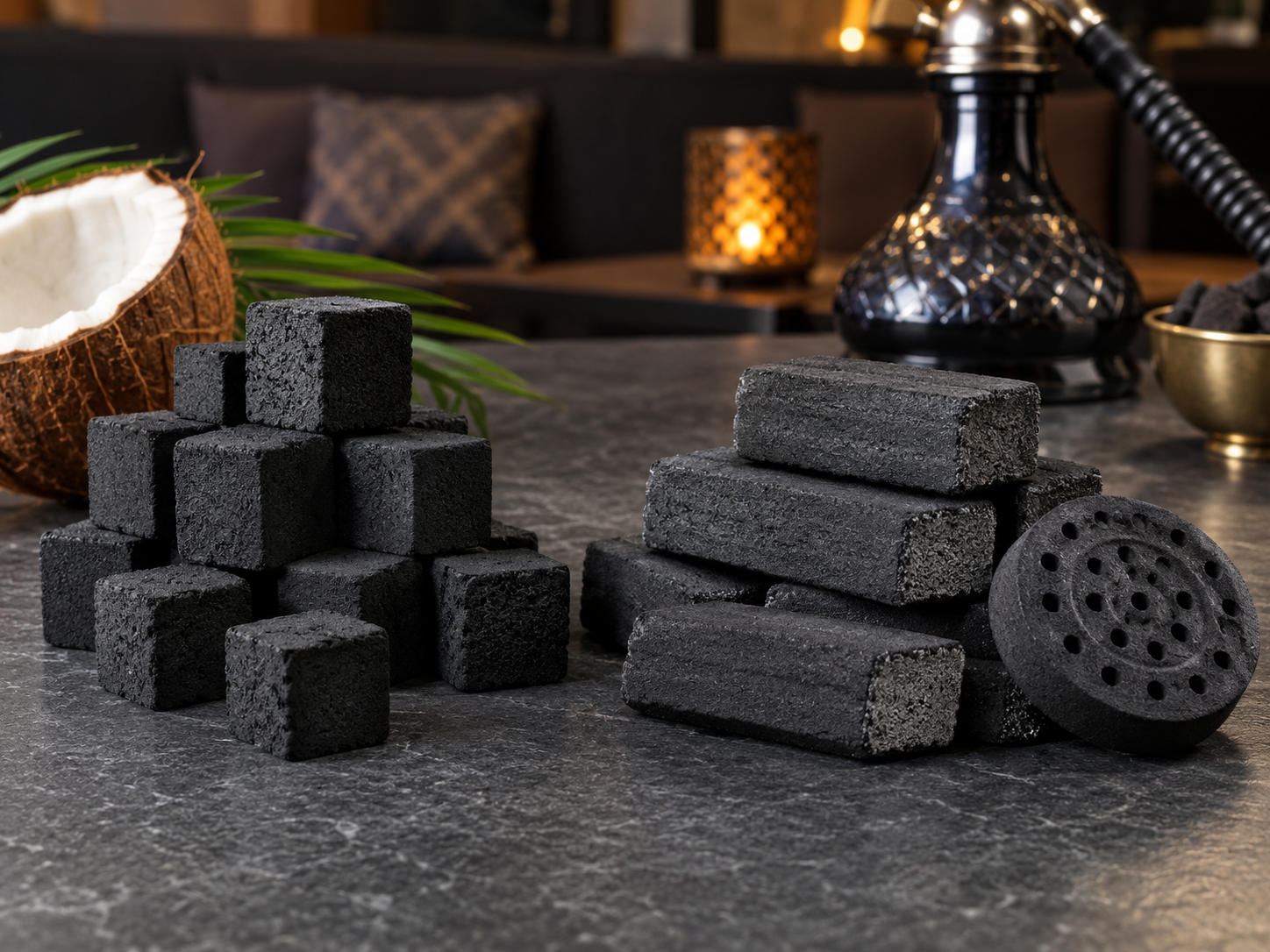
Compare natural coconut shell charcoal and fruitwood quick-light charcoal by ignition method, burn performance, odor, ash, and operational needs. Use clear product specifications and controlled sampling to assess supplier claims and total landed cost before placing a wholesale order.
Why choosing hookah charcoal can be a difficult sourcing decision
For importers and distributors, hookah charcoal is rarely a simple price-per-carton decision. Buyers must balance lighting convenience, burn consistency, odor, ash behavior, customer expectations, landed cost, and compliance requirements in the destination market. A product that looks attractive on a quotation sheet may perform very differently once it reaches a retail shelf or a lounge table.
Performance can also shift across production batches, packaging formats, and shipping conditions. Humidity during transit, compression inside cartons, and storage temperature can all affect how a finished charcoal product lights and burns. That is why experienced buyers set a clear brief before requesting quotes: intended use, target market, ignition method, cube or disc dimensions, packaging format, and the documentation required for import.
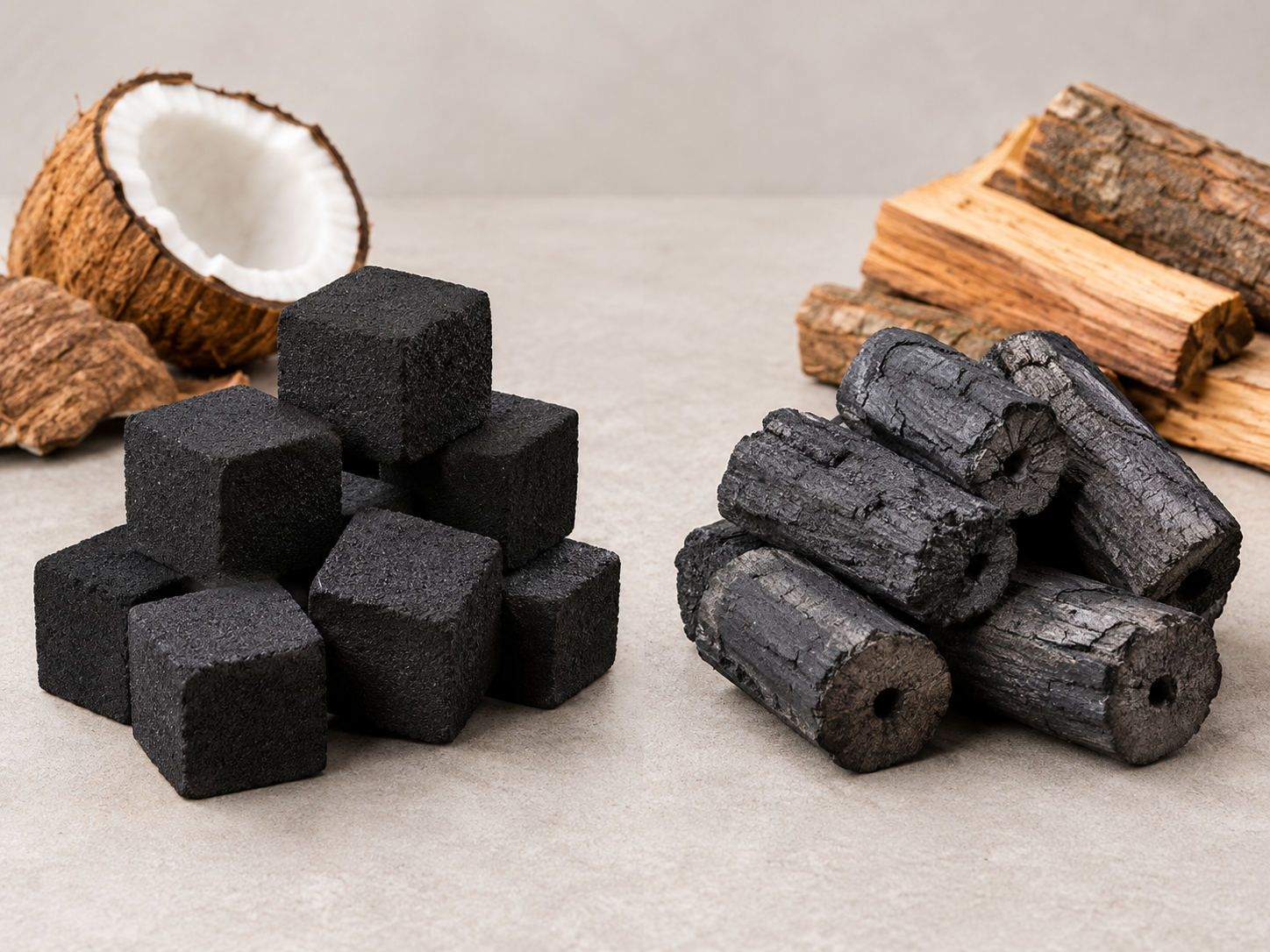
This comparison looks at two common categories in the hookah charcoal market — natural coconut shell charcoal and fruitwood quick light charcoal — and explains how to evaluate each on verified performance rather than label claims alone.
The essential difference: coconut shell charcoal versus fruitwood quick light charcoal
Coconut shell charcoal is commonly sold as natural shisha charcoal. Buyers typically light it externally on a burner or with another heat source, then assess it for heat stability, burn duration, ash volume, and odor. Because it contains no ignition aid, the lighting workflow is slower and requires equipment and instruction.
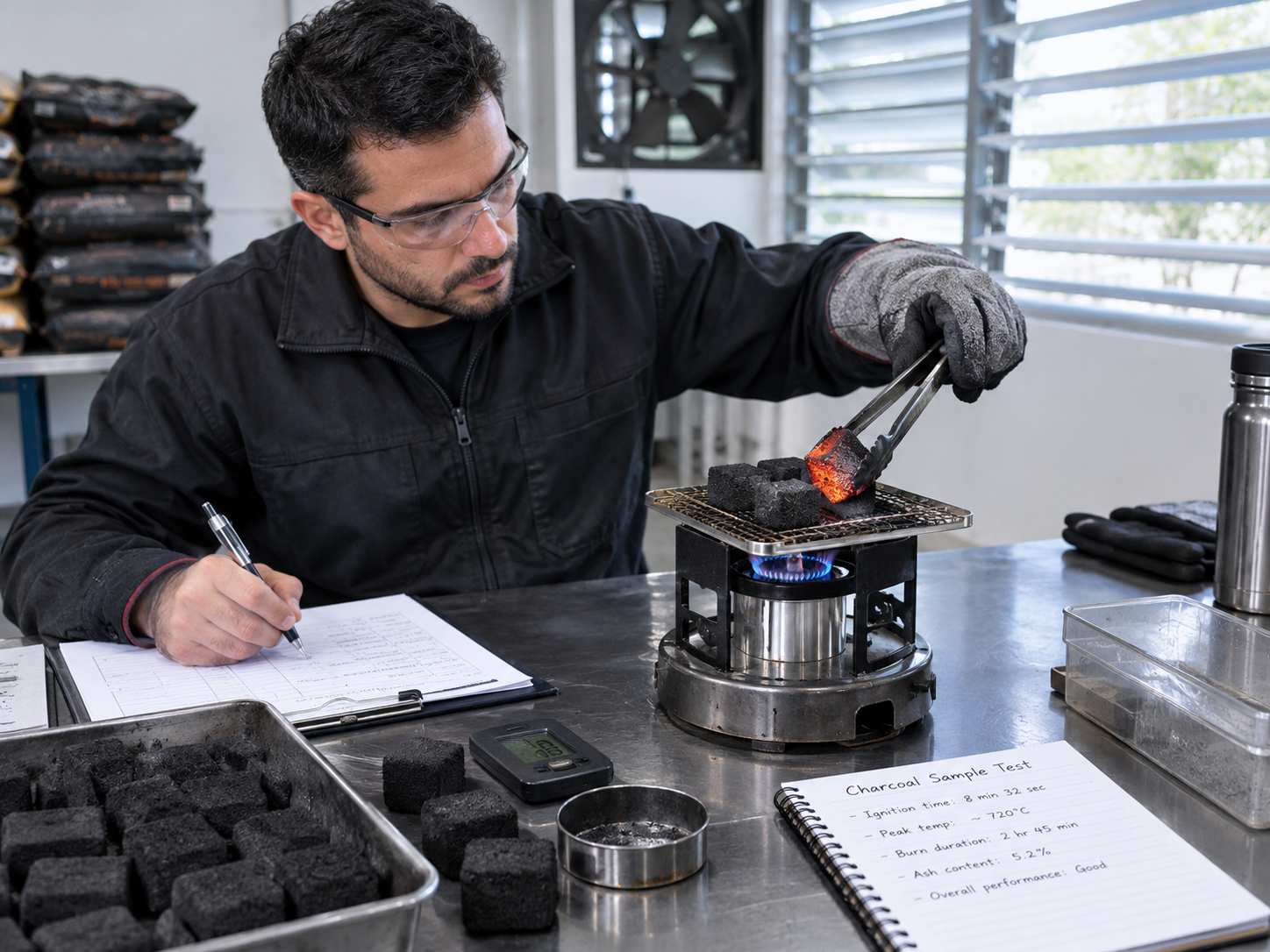
Fruit wood charcoal is made from fruit-tree wood. Fruit wood quick light hookah charcoal is formulated to ignite more readily, generally using an ignition aid, so it can be lit with a flame or a brief contact with heat. The trade-off is that lighting odor and residue behavior deserve close attention during sampling.
Do not treat "fruitwood," "quick light," and "natural" as interchangeable terms. Ask every hookah charcoal supplier to disclose the raw material, the ignition method, and the applicable safety information in writing. Compare finished products — dimensions, density, moisture, ignition behavior, and burn profile — rather than assuming that a raw-material category alone predicts performance.
For example, a large-format fruit wood block such as the 50*50*40mm Block Quick-Burning Charcoal, Fully Burning, Black Fruit Wood AA554-SBQ is designed for BBQ, outdoor cooking, and hookah use, with a 1–3 second ignition and a fully burning block format. A different product, such as the 50mm perforated quick burning charcoal fruit charcoal, is a 50 mm perforated quick-light hookah charcoal intended for hookah, shisha, and aromatherapy burners with a fruit fragrance profile. Both are fruit wood based, yet they serve different use cases and should be tested against different acceptance criteria.
Quick comparison for wholesale buyers
The table below summarizes the practical differences buyers usually weigh when comparing natural coconut shell charcoal with fruitwood quick-light products.
- Lighting workflow: quick light charcoal is designed for faster, simpler ignition, while natural coconut products require an external heat source and more preparation time.
- Use experience: compare lighting time, ignition consistency, odor during lighting, heat behavior, burn duration, and ash residue using a controlled, repeatable test.
- Operations: consider staff training, equipment needs, customer preferences, storage conditions, shipping constraints, and any market-specific product or labeling requirements.
- Commercial fit: evaluate total landed cost and repeat-purchase potential, not just ex-works price per carton.
A quick-light product may suit channels where convenience drives the purchase decision, while a natural coconut product may appeal to buyers who prioritize a particular ignition ritual. Neither is universally superior; the right answer depends on your channel and your customers.
How to evaluate product quality and verify supplier claims
Start with a written specification covering raw material, dimensions, moisture, ash, fixed carbon where relevant, ignition characteristics, packaging, and tolerances. A specification is the foundation of every later quality conversation, and it protects both sides when a batch is disputed.
Next, request representative samples and test multiple pieces from more than one batch. Record lighting time, usable heat window, total burn time, breakage rate, odor, and residue. Keep notes in a consistent format so results are comparable across suppliers. Confirm that test methods and performance claims are documented and can be compared on equal terms.
For shisha charcoal, also review packaging integrity, carton weight, traceability, and consistency between approved samples and production orders. A shisha charcoal manufacturer that cannot explain how it controls batch-to-batch variation is a risk, regardless of how good the first sample looks.
Sample performance is a starting point, not a guarantee. The real question is whether the supplier can reproduce that performance across every subsequent order.
Questions to ask a hookah charcoal supplier before placing an order
A structured questionnaire shortens the evaluation process and surfaces weak suppliers early. Consider asking the following:
- Which finished products do you make, and can you clearly distinguish natural coconut shell charcoal from fruit wood quick light products in your documentation?
- What are your production capacity, minimum order quantity, lead time, batch-control process, and export experience?
- Can you provide samples, current product specifications, safety documents, and relevant certificates for the destination market?
- For a shisha charcoal manufacturer, how are product changes, complaints, and out-of-spec batches handled?
- For a shisha charcoal exporter or bulk hookah charcoal supplier, what are the carton configuration, palletization, shipping terms, and responsibility for export documents?
Answers should be specific and verifiable. Vague responses about "high quality" or "best price" are not a substitute for documented specifications and controls.
Cost, packaging, and private-label considerations
Compare total cost per usable unit after accounting for product weight, breakage, packaging, freight, duties, testing, and expected sell-through. A cheaper carton that arrives with significant breakage or poor burn consistency can cost more in the end than a slightly higher-priced product with reliable performance.
Check whether the supplier offers carton sizes, retail packs, branding, barcodes, and language-specific labeling suited to your channel. Discuss artwork approval, packaging-material specifications, production minimums, and lead times before committing to a private-label program. A private label hookah charcoal manufacturer or hookah charcoal OEM manufacturer should provide clear approval steps and written controls for repeat orders.
Packaging is also a performance issue: moisture barriers, carton strength, and pallet configuration all influence how the product arrives and how it lights. Ask how the supplier protects quick-light formulations in humid shipping conditions.
Choosing the right product for your business model
Consider coconut shell charcoal when your customers prioritize a natural ignition workflow and you can support the required lighting equipment and instructions. Consider fruitwood quick light hookah charcoal when convenience is central to the offer and the finished product meets your market's performance and compliance requirements.
Test both options with representative buyers and compare reorder behavior, complaints, and margin before making a large inventory commitment. Avoid extrapolating from one supplier's sample to an entire material category; formulation and manufacturing controls matter far more than the category name on the box.
Many distributors eventually carry both categories, positioning natural coconut products for one customer segment and quick-light fruitwood products for another, with separate specifications and acceptance criteria for each.
Adjacent charcoal categories buyers may encounter
During supplier research you will likely encounter products outside the two main categories. Treat each as a separate sourcing inquiry with its own specification and test results.
- Bamboo charcoal and bamboo cube shisha products are separate sourcing options; request their own specifications and test results rather than assuming they perform like coconut shell products.
- Terms such as bamboo cube shisha charcoal supplier, bamboo shisha charcoal wholesale, bamboo charcoal cubes for shisha wholesale, and bamboo hookah charcoal custom can help buyers define a distinct product inquiry.
- Incense charcoal and incense charcoal for aromatherapy have different intended-use requirements; verify product suitability instead of substituting them for shisha charcoal.
- A fruit wood charcoal cubes supplier or fruit wood charcoal for hookah supplier should clarify whether the product is natural charcoal or a quick-light formulation.
These distinctions matter for compliance as well as performance. An incense charcoal manufacturer for aromatherapy may follow different labeling and safety conventions than a hookah charcoal factory serving the shisha market.
Building a reliable 2026 sourcing plan
Shortlist suppliers against product fit, documented quality controls, sample performance, compliance support, capacity, and commercial terms. Run a pilot order with agreed acceptance criteria before scaling to recurring charcoal wholesale purchases, and use a written specification and change-control process to reduce surprises between sample approval and mass production.
Search phrases such as quick light shisha charcoal exporter, fruit wood incense charcoal wholesale, and hookah charcoal manufacturer for importers can help organize supplier research, but verify each supplier's actual capabilities through samples, documentation, and reference checks. A well-organized inquiry — with your brief, specification, and acceptance criteria attached — will usually produce better and faster responses than a generic request for a price list.
Supplier capability checklist
Use the following checklist to structure your evaluation before committing to a supplier relationship.
- Confirm whether a prospective hookah charcoal factory or shisha charcoal factory in China produces the requested item directly or sources it from another manufacturer.
- For a fruit wood quick light hookah charcoal manufacturer, request details on ignition formulation, finished-product testing, labeling, and export-market documentation.
- For OEM or custom projects, clarify whether a custom hookah charcoal supplier can meet your target dimensions, packaging, quality tolerances, and order volume.
- Use category-specific searches — such as quick light hookah charcoal factory, fruit wood hookah charcoal OEM, and B2B hookah charcoal supplier — as discovery terms, then validate the business through samples and documentation.
A supplier that answers these questions clearly, consistently, and in writing is usually easier to work with over the long term than one that offers the lowest quote but cannot explain its process.
Conclusion: source for verified performance, not the label alone
Coconut shell charcoal and fruitwood quick-light products serve different lighting workflows, so the best choice depends on customer expectations and channel requirements. Make the decision using documented specifications, repeatable sample tests, compliance checks, and total landed cost.
A dependable supplier relationship is built on transparent product information, consistent batches, and clearly agreed acceptance criteria. Whether you are evaluating a large-format fruit wood block for combined BBQ and hookah use or a 50 mm perforated quick-light product for shisha and aromatherapy burners, the discipline is the same: define the brief, test the product, verify the supplier, and scale only after the pilot order meets your criteria.
Related Articles
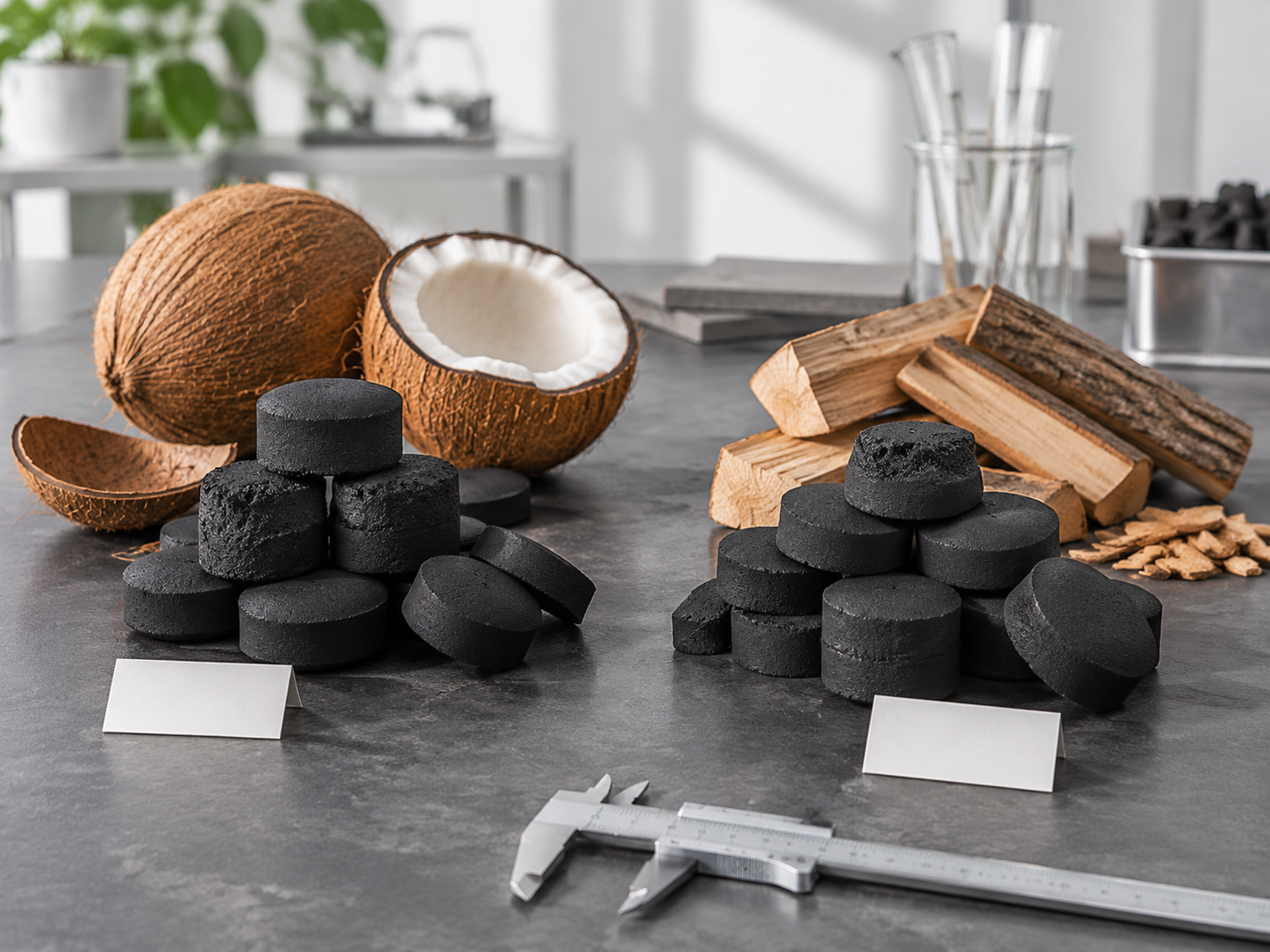
Coconut Shell vs. Fruitwood Quick-Light Charcoal: A 2026 Guide for Hookah Importers
This guide compares coconut-shell and fruitwood quick-light charcoal, focusing on the sourcing, product, and supply factors importers should verify. It offers a practical framework for evaluating samples and suppliers without assuming one feedstock is universally better.
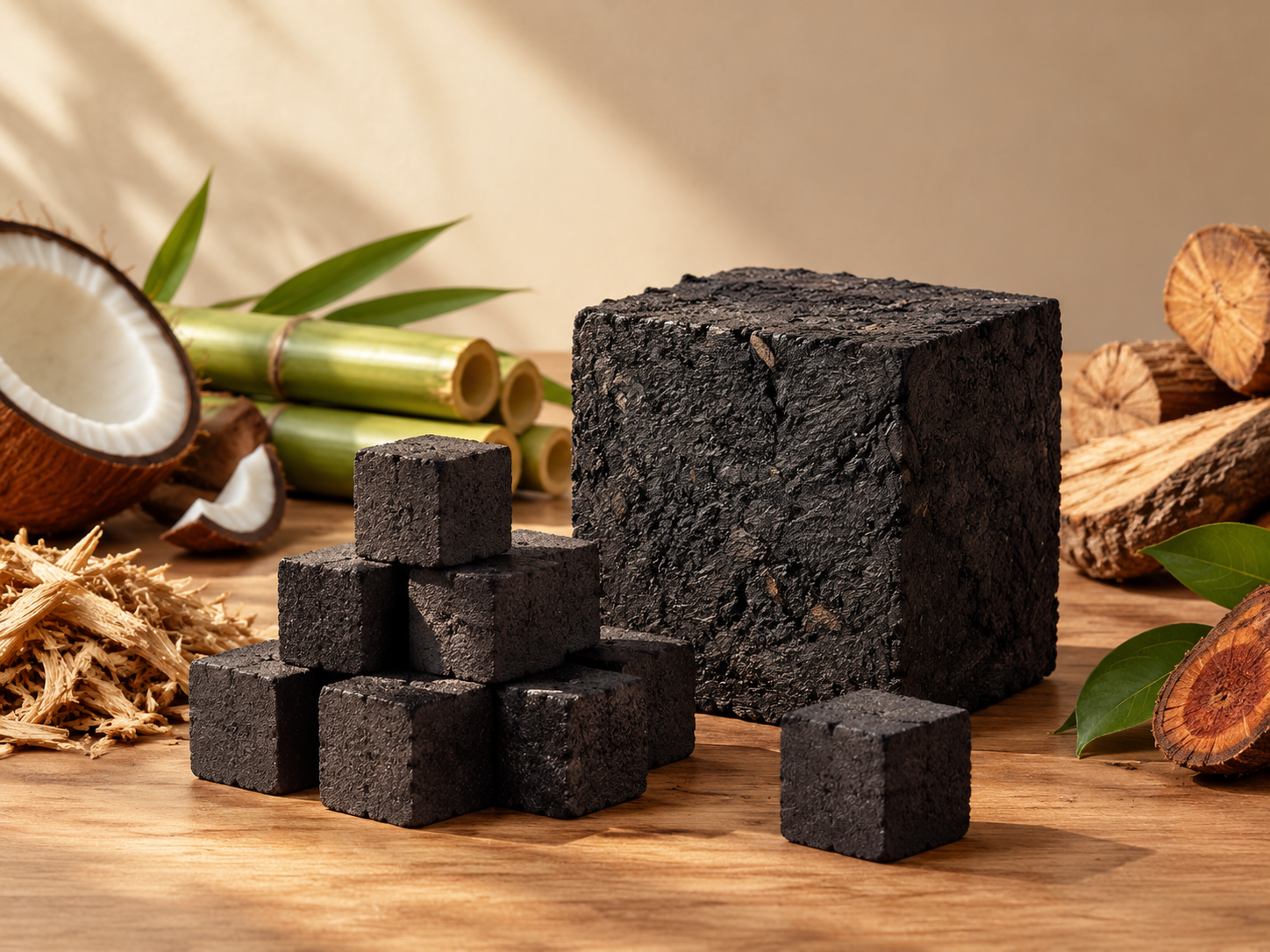
How to Choose Charcoal by Material, Format, and Specifications
Labels such as “natural” don’t guarantee consistent performance or suitability for a particular use. This guide compares coconut shell, bamboo, and fruit wood charcoal, highlighting the specifications buyers should verify before choosing.