
Quick-Light Charcoal Isn’t Automatically Low Quality

Quick-light and coconut-shell charcoal are designed for different uses, and ignition method alone does not determine product quality. Buyers should assess each product by factors such as consistency, odor, ash, burn performance, safety testing, and packaging.
Introduction: Why Buyers Still Equate Quick-Lighting Charcoal With “Low Quality”
Walk through any trade show, sourcing platform, or distributor meeting, and you will hear the same assumption repeated: quick light charcoal is the cheap option, while coconut-shell shisha charcoal is the premium one. Importers, distributors, lounge operators, and retail buyers often judge an entire product category by its ignition method rather than by measurable performance. That single assumption has shaped purchasing decisions, shelf positioning, and even price negotiations across the charcoal trade — usually without any real testing behind it.
The concerns themselves are legitimate. Buyers worry about off-odor during ignition, excessive smoke, unpredictable ash, lighting reliability, chemical safety, damaged packaging, and inconsistent burn duration. These are real problems that appear in low-grade products, and once a buyer has been burned by a bad batch, it is easy to blame the category instead of the supplier. There is also a genuine end-user concern behind the debate: customers using quick-light products for hookah or incense may worry about smoke exposure, indoor ventilation, and general product safety. Those worries deserve honest answers, not dismissal.
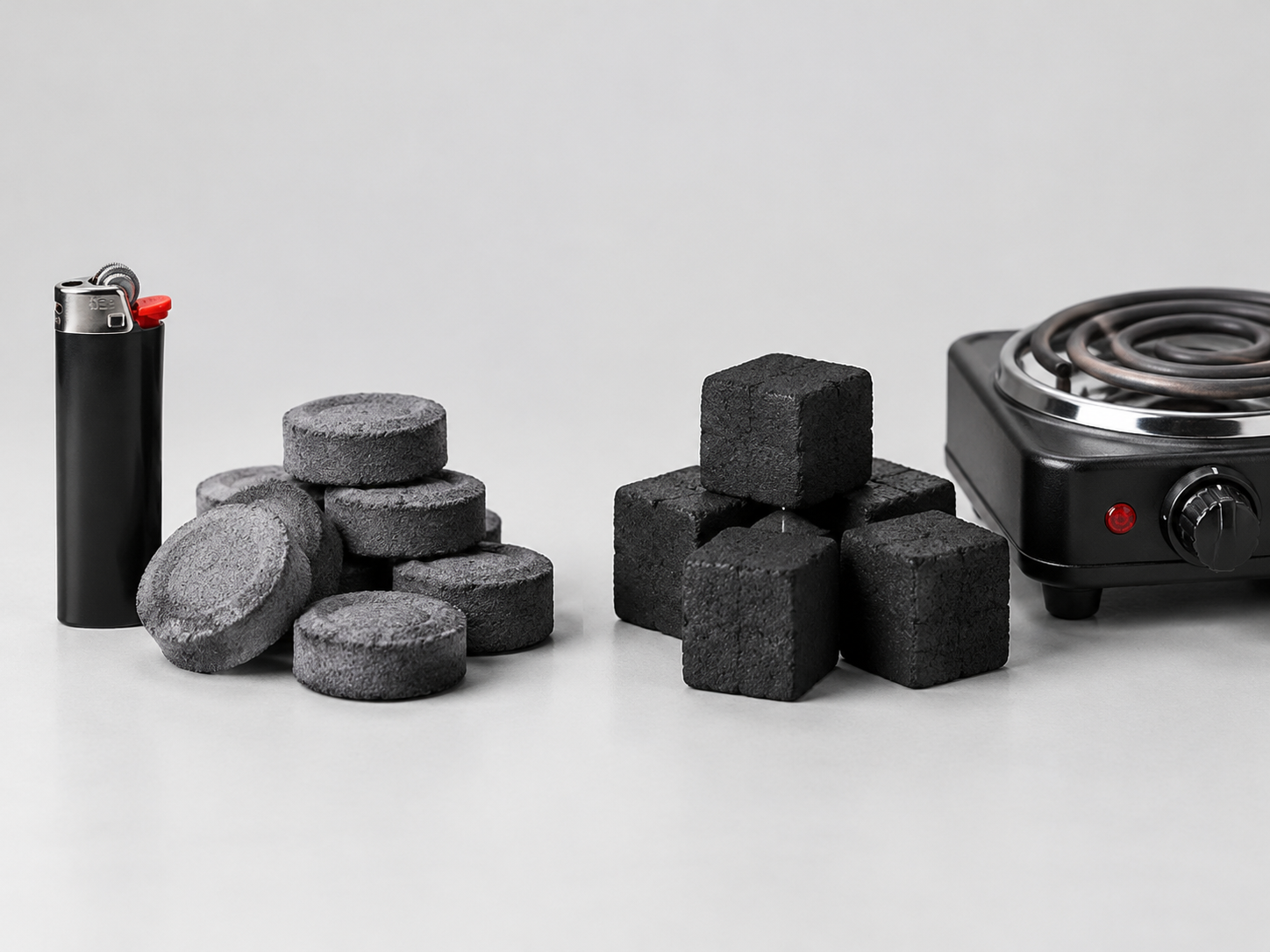
This article takes a clear position: quick light charcoal is not inherently lower quality than coconut-shell charcoal. It is engineered for a different lighting experience, and it should be evaluated against the correct quality standards for its intended use. Once buyers separate ignition method from quality grade, sourcing decisions become far more accurate — and far more profitable.
The Core Myth: Different Ignition Methods Do Not Define Product Quality
The mechanical difference between the two categories is simple. Coconut-shell hookah charcoal is dense, natural, and typically requires an external heat source such as an electric burner or coil to reach full ignition. Quick light charcoal contains an ignition layer or an ignition-supporting formulation designed to catch flame directly — a lighter or a match is enough to start it. That is a design difference, not a quality difference.
Quality is determined by a much longer list of variables: raw-material selection, carbonization temperature, formulation control, combustion consistency, ash behavior, odor control, safety testing, and packaging integrity. None of those variables are dictated by whether a tablet lights in thirty seconds or ten minutes. A poorly made coconut-shell cube can smell, crumble, and burn unevenly. A well-made quick light charcoal can deliver stable heat, minimal off-odor, and clean ash for its entire intended session.
A practical comparison makes this obvious. Premium shisha charcoal and premium quick light charcoal can both be high quality when each is manufactured for its intended use. The mistake is treating product category as a quality grade — as if “natural” automatically means superior and “quick-lighting” automatically means compromised. Buyers who make that leap end up overpaying for one category and undervaluing a perfectly reliable product in the other.
Quick Light Charcoal vs. Coconut Shell Shisha Charcoal: The Real Differences
The two categories serve different applications. Quick light charcoal is built for convenience-focused hookah sessions, incense, resin, and aromatherapy use, where fast setup matters more than a two-hour burn. Coconut-shell charcoal is built for longer hookah sessions and for consumers who prefer a natural-charcoal preparation ritual.
Ignition tells the same story. Quick light charcoal lights in seconds with a lighter or match, which makes it practical for travel, outdoor settings, and first-time users. Coconut-shell charcoal usually needs a burner or electric coil, plus several minutes of waiting before it is ready.
Session characteristics differ as well. Coconut-shell charcoal often supports a longer burn and a lower ash profile, which suits long lounge sessions. Quick-light products prioritize fast setup, portability, and immediate use — advantages that matter enormously in retail channels serving casual consumers.
It is also worth correcting a common misconception: quick light charcoal is not made from one fixed material. Depending on the manufacturer’s formula, it can be produced from fruit wood charcoal, compressed wood carbon, bamboo charcoal, or other carbonized materials. A fruit wood base, for example, can deliver excellent heat and a clean burn when the carbonization and ignition coating are properly controlled. Products such as the 50*50*40mm Block Quick-Burning Charcoal, Fully Burning, Black Fruit Wood AA554-SBQ demonstrate this well — a large fruit wood charcoal block designed for BBQ, outdoor cooking, and hookah use, with a 1–3 second ignition and full burning performance that competes with far more expensive alternatives.
Incense charcoal has its own technical requirements, separate from hookah charcoal entirely. It needs stable ember formation, controlled burn speed, minimal fragrance interference, and practical sizing for resins or aromatic materials. A disc that works beautifully under a hookah bowl may be entirely wrong for a resin burner, and vice versa. Products like the 50mm perforated quick burning charcoal fruit charcoal are engineered for exactly this crossover — a 50 mm perforated quick-light format suited to hookah, shisha, and aromatherapy burners, with a fruit-based composition that keeps aroma interference low.
What High-Quality Quick Light Charcoal Actually Looks Like
If quick light charcoal is not automatically low quality, what does a genuinely good product look like? Buyers can evaluate it against a concrete checklist:
- Fast, even ignition without repeated relighting, sputtering, or unpredictable sparks.
- Stable heat output that supports the intended hookah charcoal or incense charcoal application without premature burnout.
- Consistent dimensions across tablets, discs, cubes, and rolls, so retail performance is predictable from unit to unit.
- Low off-odor after the ignition phase, with a formula designed not to overpower shisha flavors or incense aromas.
- Controlled ash formation and reduced breakage during shipping and handling.
- Reliable moisture control, density, and compression strength, supported by packaging that protects the product in transit.
- Clear use instructions, ventilation guidance, and product-specific safety labeling.
Notice that none of these criteria reference coconut shells. They reference engineering discipline — the same discipline required to make any premium charcoal product, regardless of feedstock or ignition method.
Why Manufacturing Quality Matters More Than the Raw Material Name
Coconut shell, bamboo charcoal, and fruit wood charcoal are feedstocks. They are inputs, not automatic proof of superior or inferior quality. A coconut shell that is under-carbonized produces weak, smoky charcoal. A fruit wood batch that is properly carbonized and precisely formulated produces a clean-burning, high-heat product. The material name on the packaging tells you far less than the process behind it.
What actually determines final performance is the production chain: carbonization temperature, sieving, binder selection, compression pressure, drying conditions, ignition-coating consistency, and quality inspection at every stage. A fruit wood quick light hookah charcoal manufacturer can produce a genuinely premium product when raw materials are properly carbonized and the ignition treatment is carefully controlled. Conversely, a bamboo cube shisha charcoal supplier may offer strong heat performance on paper, but cube shape and bamboo feedstock alone do not guarantee batch-to-batch consistency.
This is where professional production controls separate serious suppliers from trading intermediaries. A capable hookah charcoal factory runs batch testing, moisture checks, drop tests, ignition tests, burn-time testing, and odor evaluation as standard procedure — not as a favor to a large customer. Those controls are what allow a buyer to reorder with confidence six months later and receive the same product.
Choosing the Right Charcoal by Application, Not by Assumption
The correct way to choose charcoal is to start with the end user, not the raw material. Quick light charcoal is the right recommendation for travelers, convenience-oriented consumers, beginner users, and incense or resin users who need easy ignition. It removes the burner, the waiting time, and the setup friction that discourage casual customers.
Natural coconut, bamboo, or fruit wood charcoal cubes remain the right choice for hookah consumers who prioritize extended sessions, high heat retention, and a traditional preparation process. These users are not looking for speed — they are looking for endurance and a clean, steady heat curve.
Incense is a third category with its own logic. An incense charcoal manufacturer for aromatherapy products should optimize for clean, stable burning and fragrance neutrality rather than hookah-style heat output. Burn speed, disc diameter, and ember stability matter more here than maximum temperature.
For distributors, the strategic conclusion is straightforward: carry both quick-light and natural shisha charcoal ranges to serve distinct customer segments, instead of positioning one as universally better. A portfolio that covers convenience buyers, traditionalists, and incense users captures more shelf space and more repeat revenue than a single-category bet.
One safety note applies across every category: all charcoal products should be used only in well-ventilated areas, with product instructions followed carefully. Proper ventilation guidance on packaging is a mark of a responsible supplier, not a regulatory afterthought.
Buyer Checklist for Charcoal Wholesale and Private-Label Sourcing
When evaluating suppliers, move past category assumptions and into specifications. A structured sourcing process protects margin and reputation.
- Request full specifications: raw materials, size, weight, moisture content, ash percentage, burn time, ignition time, odor profile, and packaging configuration.
- Test samples under real conditions: order from a hookah charcoal supplier and evaluate performance in your actual target market before committing to bulk orders.
- Ask about customization: OEM formulas, custom disc sizes, branded foil rolls, retail boxes, multilingual labels, and export-ready master cartons.
- Compare landed cost against risk: for charcoal wholesale programs, weigh defect rates, breakage resistance, burn consistency, and customer complaint risk alongside price per container.
- Verify quality documentation: confirm whether a shisha charcoal manufacturer can provide QC records, production photos, sample retention, and pre-shipment inspection support.
- Evaluate private-label capability: assess a private label hookah charcoal manufacturer on branding flexibility, minimum order quantities, lead times, formula stability, and compliance labeling.
Buyers who run this checklist consistently tend to discover that the biggest quality gaps exist between suppliers — not between product categories.
Market Context: Why Product Segmentation Is Growing
The numbers support what experienced buyers already sense. A reported 8.1 billion market figure associated with custom manufacturing for hookah, BBQ, and incense indicates broad, sustained demand for specialized charcoal products and private-label differentiation. At the same time, a reported 60.37 million coconut shell charcoal market estimate confirms that natural charcoal remains an important and growing category — but clearly not the only category buyers need to stock.
There is another useful signal: a reported 3% buyer-criteria figure from charcoal market leadership research suggests that relatively small improvements in quality consistency, packaging, and supplier reliability can meaningfully influence purchasing decisions. In a market where most products look similar on a spec sheet, execution details become the differentiator.
The accurate framing of this trend is not “natural is winning” or “quick-light is fading.” The market is moving toward application-specific charcoal solutions: quick-light discs, natural cubes, bamboo shisha charcoal wholesale formats, and specialized fruit wood incense charcoal wholesale products. Each format exists because a specific customer segment needs it.
How Importers Can Build a Stronger Charcoal Portfolio
Importers and distributors who want durable growth should structure their catalog deliberately rather than chasing a single “best” product.
- Create separate product lines for quick-light hookah charcoal, natural coconut or bamboo shisha charcoal, and incense charcoal, instead of forcing one product to satisfy every use case.
- Source quick-light products from a quick light hookah charcoal factory with proven ignition consistency and low-odor performance, since these are the two attributes customers notice immediately.
- Work with a custom hookah charcoal supplier to tailor disc diameters, burn duration, packaging, brand positioning, and target-market labeling.
- Consider a B2B hookah charcoal supplier or hookah charcoal manufacturer for importers that can support mixed-container orders across quick-light, bamboo, fruit wood, and natural charcoal categories — reducing freight cost per SKU.
- For regional sourcing, assess a shisha charcoal factory in China on quality systems, export experience, customization capacity, and transparent sampling procedures rather than on price alone.
Suppliers that support this portfolio approach — offering fruit wood hookah charcoal OEM programs, bamboo hookah charcoal custom formats, and flexible private-label packaging — give importers the tools to serve multiple segments without multiplying supplier relationships.
Conclusion: Quick Light Charcoal Should Be Judged on Performance
The myth deserves to be retired. Quick light charcoal is not lower quality by definition. It is a convenience-driven charcoal category with its own engineering requirements, its own performance standards, and its own customer base. Judging it against coconut-shell charcoal is like judging a motorcycle against a truck — both are well-built machines, and they are built for different jobs.
The correct buyer mindset is application-first. Compare products by intended use, safety, ignition reliability, heat stability, odor, ash behavior, durability, and supplier quality controls. Those criteria will identify a good product in any category and expose a bad one just as quickly.
Quick-light and natural shisha charcoal both belong in a complete product portfolio, alongside dedicated incense formats. The real competitive advantage is not choosing a side in the debate — it is sourcing each category from a manufacturer that can prove its quality with data.
Request samples, compare tested specifications against your target market’s actual conditions, and partner with a hookah charcoal OEM manufacturer that can match the product formula to the market it will serve. That is how importers turn a tired assumption into a stronger, more profitable catalog.
Related Articles
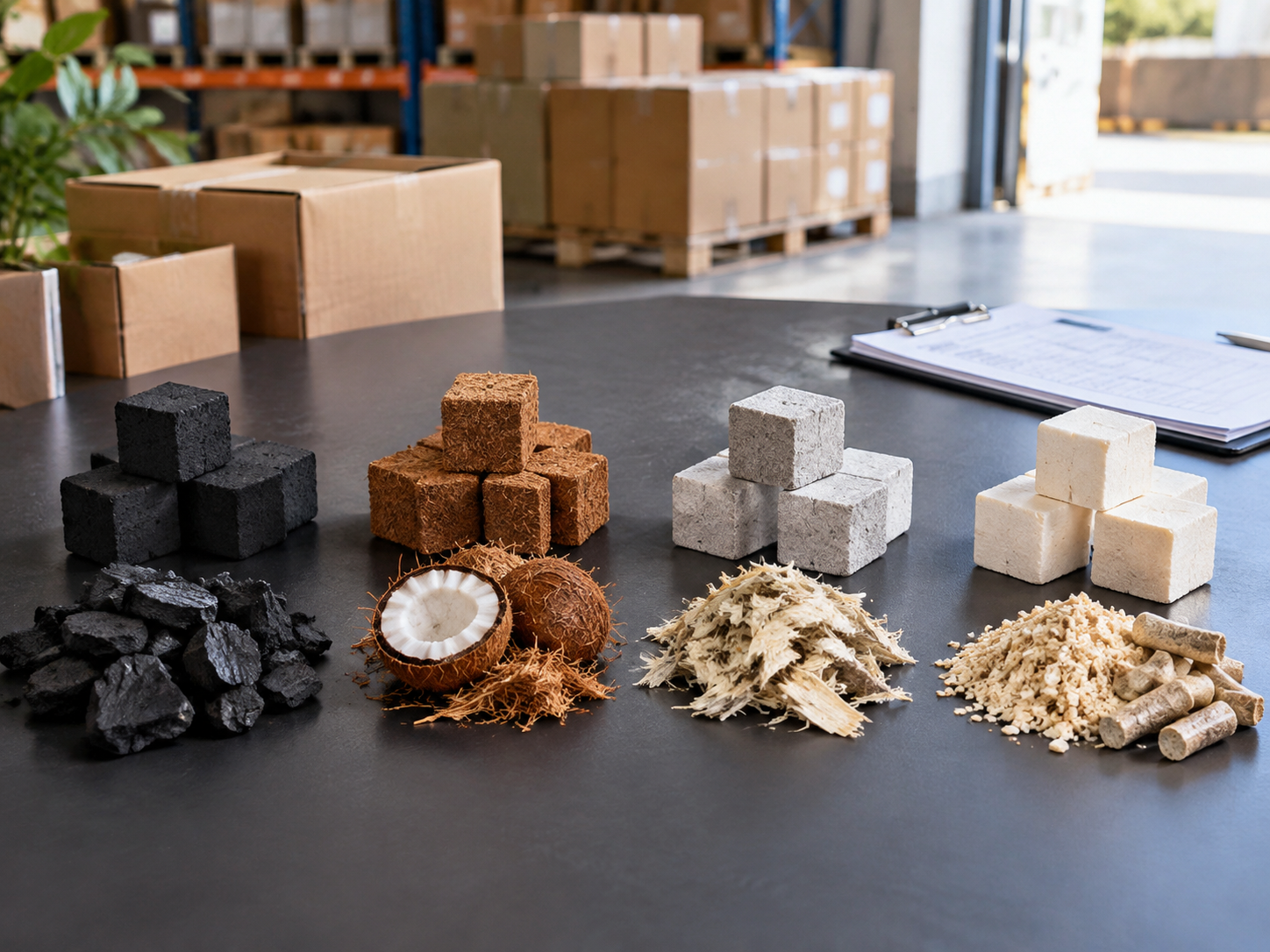
2025 Hookah Charcoal Market Outlook: Why Importers Are Diversifying Beyond Coconut Shell Charcoal
Importers are reassessing hookah charcoal sourcing as supply disruptions, changing logistics costs, product consistency, and demand for variety make single-source strategies riskier. The article outlines a practical approach to comparing coconut shell charcoal with alternatives such as bamboo, fruit wood, and quick-light products, emphasizing documented specifications, supply reliability, compliance, and safe handling.

How to Evaluate Alternatives to Coconut Shell Charcoal: A 7-Step Importer Checklist
Switching charcoal feedstocks can affect heat, ash, odor, breakage, delivery reliability, and brand reputation—not just purchase price. This checklist helps importers define product requirements and compare shisha, quick-light, and alternative charcoal under consistent conditions, while keeping incense charcoal specifications separate.