
How to Source Hookah Charcoal Without Letting a Low Quote Become a Costly Mistake

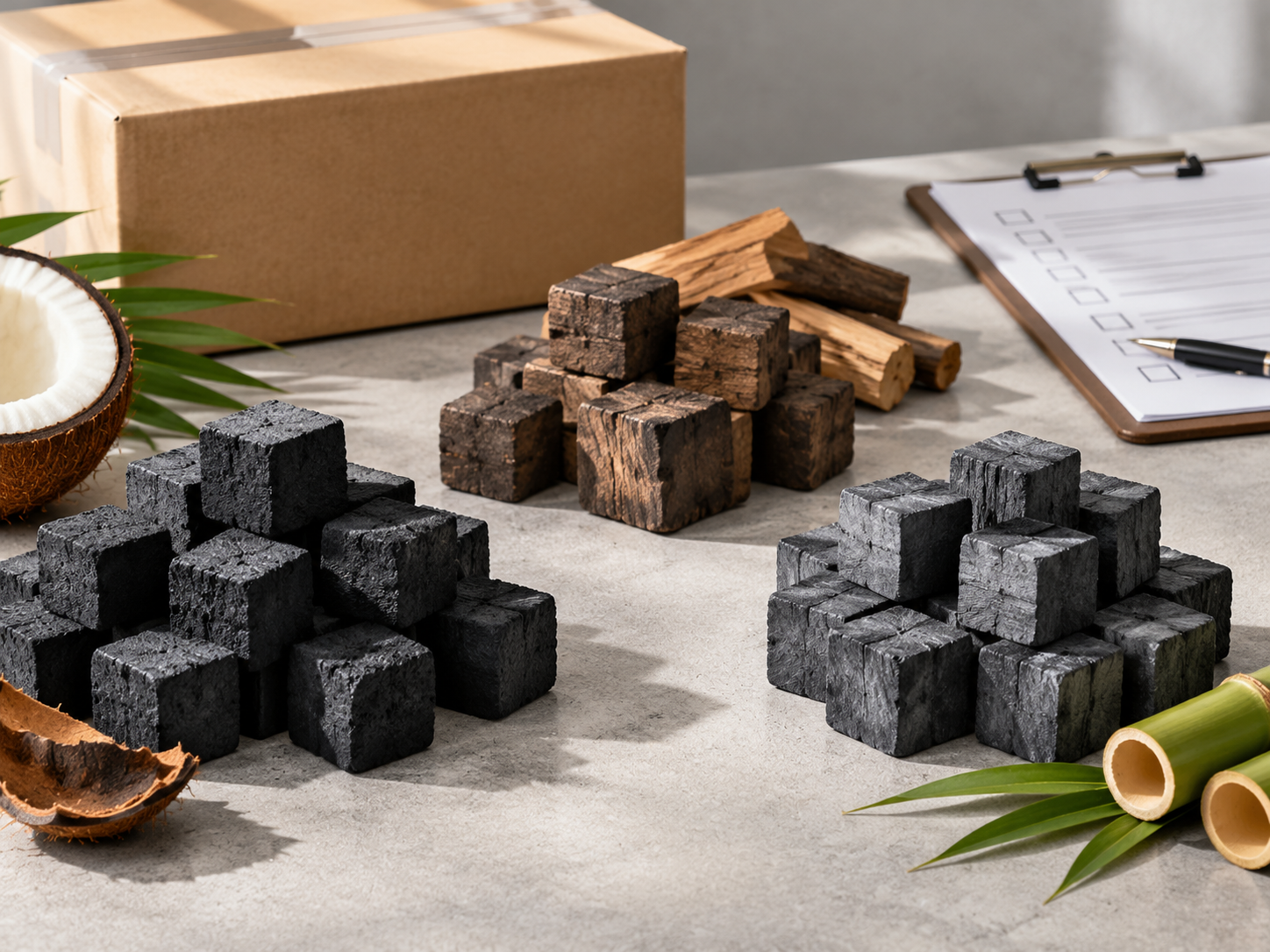
This 2026 procurement guide compares coconut shell, fruitwood quick-light, and bamboo cube charcoal, showing how product performance and intended use affect sourcing decisions. It also highlights the risks of judging suppliers by unit price alone and the need to evaluate ignition, odor, ash, heat, and product consistency.
Introduction: Why the Cheapest Charcoal Quote Can Become the Most Expensive Import Decision
Every importer has seen the same email: a factory offers hookah charcoal at a price that undercuts every other quotation in the inbox by fifteen or twenty percent. The margin looks irresistible on a spreadsheet. Then the container arrives, and the real costs begin to surface — slow ignition that frustrates retail customers, excessive ash that ruins a session, odor complaints on social media, cracked cubes at the bottom of every carton, rejected shipments at port, and repeat orders that quietly disappear.
The unit price on a proforma invoice is only one line in a much longer cost equation. A cheap quote can be erased entirely by damage rates, customer returns, chargebacks from distributors, and the slow erosion of a brand that once stood for quality. For importers building a charcoal category, the sourcing decision is not about finding the lowest number. It is about finding the product that performs consistently enough to keep buyers coming back.
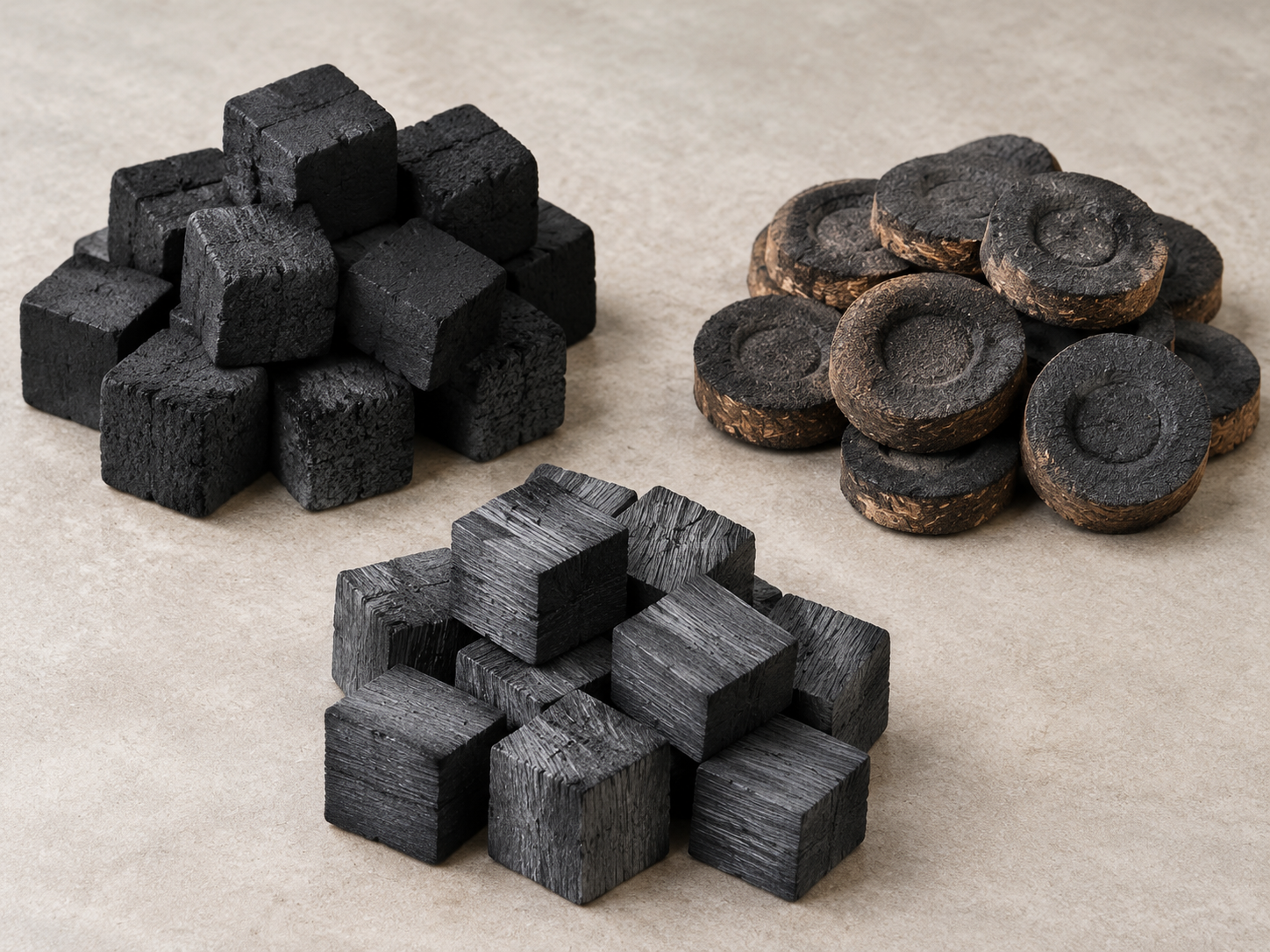
There is also a user-safety and experience dimension that cannot be ignored. Charcoal produces hot air, smoke, and — in the case of some quick-light formats — chemical fumes during ignition. Buyers must evaluate ignition behavior, odor before and during use, sparking, and heat consistency, because end users may experience irritation from smoke or fumes if a product is poorly made or incorrectly used. A supplier that cannot speak clearly about these factors is a supplier that has not tested its own output.
Different sales channels also demand different products. Premium hookah lounges and specialty retailers generally want natural coconut shell shisha charcoal that burns long and clean. Convenience-led retail, travel formats, and incense channels often prefer quick light charcoal that ignites without a burner. Aromatherapy and resin-burning applications call for incense charcoal with controlled ignition and low residual odor. Treating these as one interchangeable category is one of the most common and costly sourcing mistakes.
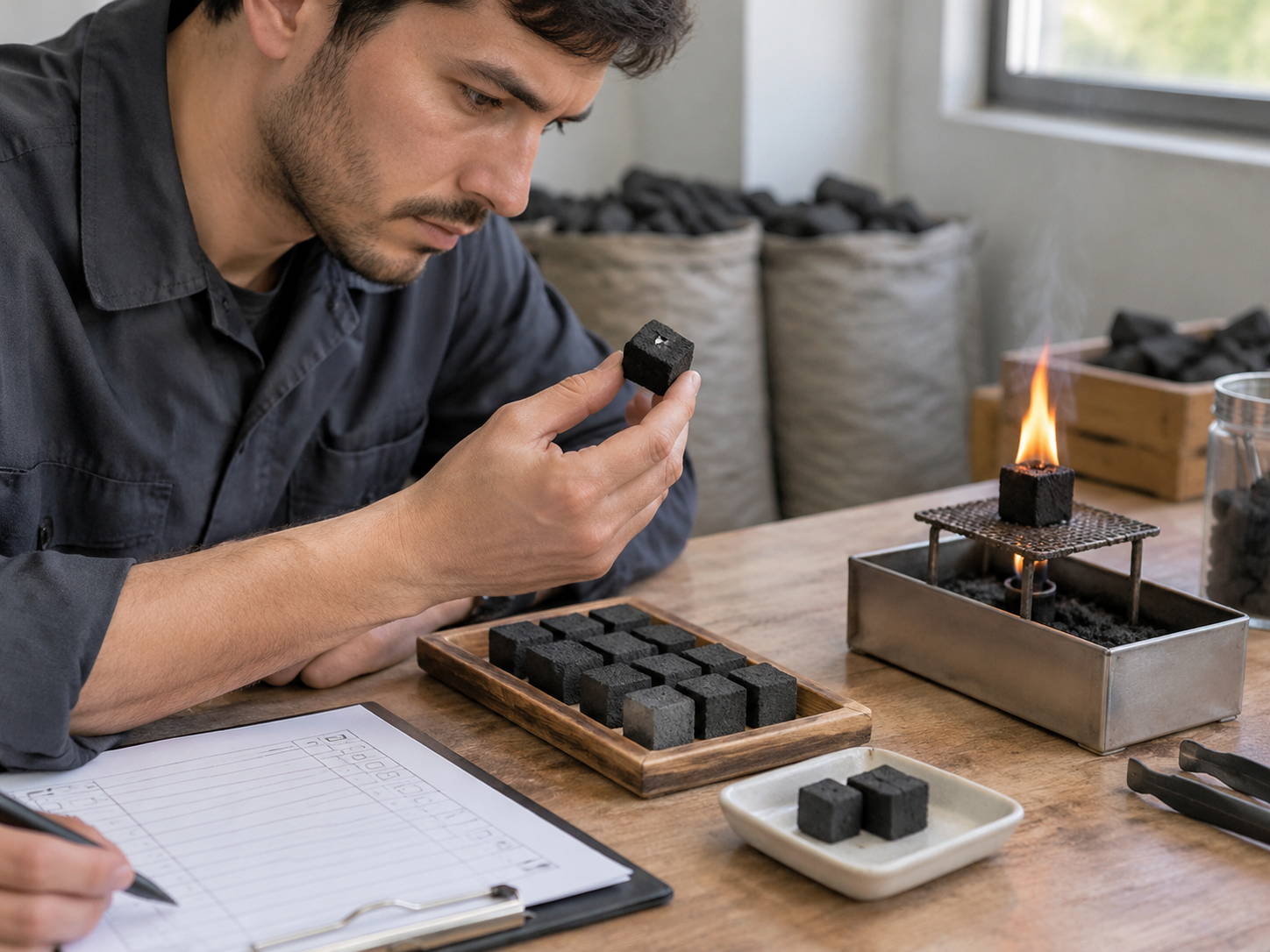
This article is a practical 2026 procurement guide for distributors, private-label brands, wholesalers, and importers comparing three product families: coconut shell hookah charcoal, fruitwood quick-light charcoal, and bamboo cube shisha charcoal. It covers performance differences, procurement risks, testing protocols, landed-cost modeling, factory qualification, and product-to-market matching — so that the next container you book is a category decision, not a gamble.
The Three Charcoal Categories Importers Need to Compare
Before comparing suppliers, importers need a clear definition of what they are actually buying. The three categories below overlap in appearance but differ fundamentally in raw material, manufacturing process, ignition method, and intended use.
Coconut Shell Hookah Charcoal
Coconut shell hookah charcoal is a compressed natural charcoal, typically produced by carbonizing coconut shells, grinding the carbon, mixing it with a binder (often starch), and pressing it into cube, flat, finger, or hexagonal shapes. When manufactured correctly, it is valued for long burn time, stable heat output, low odor, and low ash residue. It is the benchmark product for premium shisha consumption and the category most associated with lounge-grade performance.
Fruit Wood Charcoal
Fruit wood charcoal is made from carbonized fruitwood material — orchard trimmings, pruned branches, and similar feedstock — and may be supplied as cubes, discs, blocks, or other formats. Product quality depends heavily on carbonization control, binder selection, pressing density, and the intended end use. A fruit wood charcoal cubes supplier producing material for BBQ may deliver a very different product from one formulating for hookah or incense applications.
Fruitwood Quick Light Charcoal
Fruitwood quick light charcoal is instant-light discs or tablets treated with an ignition agent so the product lights quickly with a match or lighter, without a separate charcoal burner. It is widely used as incense charcoal and in some hookah applications. The convenience is genuine, but so are the procurement obligations: ignition-agent disclosure, odor control, transport classification, and market-specific labeling all require attention.
A representative product in this family is the 50*50*40mm Block Quick-Burning Charcoal, Fully Burning, Black Fruit Wood AA554-SBQ — a large fruit wood charcoal block designed for BBQ, outdoor cooking, and hookah use. It offers 1–3 second ignition and full burning, making it a strong fit for buyers who need fast lighting in a substantial block format rather than a thin disc.
Another format common in this category is the 50mm perforated quick burning charcoal fruit charcoal, a 50 mm perforated quick-light hookah charcoal intended for hookah, shisha, and aromatherapy burners. The perforated design supports airflow during ignition, and the fruit-fragrance profile gives brands a differentiated sensory story for convenience-led retail.
Bamboo Charcoal Cubes for Shisha
Bamboo charcoal cubes for shisha are compressed bamboo-charcoal products positioned as a renewable alternative to coconut shell material. Bamboo grows quickly and regenerates after harvest, which supports a credible sustainability narrative. Performance, however, varies significantly by raw-material processing, carbonization completeness, cube density, and factory formulation. Renewable feedstock messaging alone is not a performance specification.
Natural vs. Quick Light: Not Interchangeable
One clarification deserves its own paragraph: "natural charcoal" and "quick light charcoal" should never be treated as interchangeable procurement categories. They differ in ignition method, chemical treatment, safety documentation, packaging requirements, storage considerations, and consumer expectations. A buyer who substitutes one for the other without re-testing is inviting complaints, returns, and possibly compliance problems.
At-a-Glance Comparison: Coconut Shell vs. Fruitwood Quick-Light vs. Bamboo Cube Shisha Charcoal
The table below summarizes the practical differences importers should weigh before allocating budget across categories. It is a starting framework, not a substitute for your own testing.
- Raw material: Coconut shell offers a dense, shell-based feedstock with consistent carbon structure. Fruitwood relies on wood-charcoal supply and processing control. Bamboo charcoal uses fast-growing bamboo feedstock with variable density depending on species and processing.
- Ignition: Fruitwood quick-light products generally ignite fastest — some block formats in 1–3 seconds. Coconut shell and bamboo cube shisha charcoal normally require an external burner or electric heater and several minutes to reach full red heat.
- Heat duration: Coconut shell is commonly favored for longer sessions and stable heat curves. Bamboo cube performance can be competitive when density and carbonization are well controlled. Quick-light discs prioritize convenience over long-duration heat and typically run shorter sessions.
- Odor and taste impact: Natural charcoal should be assessed for neutral odor before and during use. Quick-light products require especially strict testing for ignition-agent smell and after-lighting residue, since these directly affect the consumer experience.
- Ash: Request ash-content data, ash color, ash cohesion, and real-use ash behavior. Marketing claims about "low ash" mean little without batch test data and a burn demonstration.
- Breakage risk: Dense cubes may still crack if drying, packing, palletization, or container loading is poorly controlled. Breakage is a logistics problem as much as a manufacturing one.
- Target channel: Premium hookah lounges and specialty retailers often favor natural cubes. Incense, travel, and convenience-driven customers may prefer quick-light formats. Aromatherapy buyers need incense charcoal with controlled ignition and low residual odor.
Coconut Shell Shisha Charcoal: Best Fit, Strengths, and Procurement Risks
Coconut shell shisha charcoal remains a mainstream choice for importers seeking stable heat, long burn time, and a premium natural-charcoal positioning. It is the product most consumers associate with quality shisha sessions, and it anchors the upper tier of most hookah charcoal assortments.
Common procurement formats include 22 mm, 25 mm, 26 mm, and 27 mm cubes, plus flats, fingers, hexagons, and customized shapes. Cube size affects heat output, session length, and compatibility with different heat-management devices, so size selection should follow the target market rather than factory convenience.
Buyer evaluation criteria should include fixed carbon, ash percentage, moisture, volatile matter, burn time, odor, spark behavior, cube density, and crush resistance. These are the parameters that determine whether a container performs in the market or generates complaints.
Supply risks are real and worth planning around:
- Seasonal raw-material availability that affects price and lead time.
- Inconsistent carbonization between batches, producing variable burn performance.
- Excessive starch binder that increases ash and odor.
- Uneven drying that leads to cracking, dust, and breakage in transit.
- False or unsupported low-ash claims that do not survive independent testing.
- Moisture absorption during ocean transit, particularly in humid routes.
Market context is useful but should be handled carefully. Coconut shell charcoal market-growth reports can support the case for category relevance, but importers should validate region-specific demand, supply availability, and price assumptions before committing volume. A growth chart for the global category does not guarantee demand in your specific market at your specific price point.
Coconut shell charcoal is recommended for importers sourcing premium hookah charcoal, private-label retail lines, lounge-grade products, and bulk hookah charcoal programs. It is the category that most reliably supports a quality-led brand position.
Fruitwood Quick-Light Charcoal: Best Fit, Strengths, and Procurement Risks
The core value proposition of quick light charcoal is fast, convenient ignition without a separate charcoal burner. For consumers who light charcoal on a balcony, at a picnic, or in a small apartment, that convenience is the entire purchase decision.
Importers should differentiate fruitwood quick-light hookah charcoal from fruit wood incense charcoal wholesale products. End-use expectations, safety requirements, packaging, and performance targets differ. Incense charcoal may be optimized for controlled smoldering and low residual odor, while hookah quick-light products must deliver enough heat for a session. Assuming one specification covers both applications is a common sourcing error.
Main Strengths
- Easy consumer use with a match or lighter — no burner required.
- Portability and suitability for travel, outdoor, and small-space use.
- Strong fit for incense burning, resin use, aromatherapy, and convenience-led retail formats.
- Fast ignition that supports impulse purchasing and single-session packaging.
Main Risks
- Ignition smell that lingers into the session or the room.
- Visible sparks during lighting, which raise safety concerns.
- Chemical residues from the ignition agent if formulation is poor.
- Inconsistent disc thickness affecting burn time and heat output.
- Short heat duration compared with natural cubes.
- Rapid ash formation that requires more frequent replacement.
- Customer sensitivity to fumes, particularly in enclosed spaces.
Supplier documentation for quick-light products should include safety data, ingredient and ignition-agent disclosure where applicable, transport classification review, warning-label requirements, and market-specific compliance checks. These are not optional extras — they are part of the product.
A fruit wood quick light hookah charcoal manufacturer should provide batch testing, lighting demonstrations, burn-time evidence, and packaging samples before the buyer approves mass production. If a supplier cannot show an unedited lighting video and a batch-specific test report, the buyer is approving a promise rather than a product.
Quick-light products should be positioned as an application-specific purchase rather than a direct replacement for premium natural shisha charcoal. They serve a different customer with different priorities.
Bamboo Cube Hookah Charcoal: Best Fit, Strengths, and Procurement Risks
Bamboo charcoal is an alternative feedstock with a sustainability-oriented story and growing relevance in natural-charcoal sourcing conversations. For brands looking to differentiate on renewable materials, it offers a narrative that coconut shell cannot fully match.
Bamboo charcoal cubes for shisha wholesale should be evaluated by actual heat curve and ash behavior, not by renewable-material claims alone. A sustainability story does not compensate for uneven combustion or inconsistent density.
Potential Strengths
- Brand differentiation through renewable feedstock messaging.
- Dense cube formats when pressing and carbonization are well controlled.
- Possible suitability for buyers expanding beyond coconut-shell sourcing.
- Alignment with retail customers who prioritize environmental positioning.
Potential Risks
- Inconsistent cube density between batches.
- Uneven combustion producing hot spots and short sessions.
- Smell caused by incomplete carbonization.
- Binder-related performance variation.
- Limited customer familiarity in some markets, requiring education at retail.
Importers should place trial orders from a bamboo cube shisha charcoal supplier before committing to annual contracts, including controlled tests against benchmark coconut cubes using identical equipment and conditions. Only a side-by-side comparison reveals whether the bamboo product genuinely competes.
For bamboo hookah charcoal custom programs, potential formats include branded cube sizes, embossed cubes, retail-ready boxes, custom master cartons, and pallet configurations. These options allow a brand to build a distinct identity around the bamboo story rather than competing purely on price.
Performance Testing Protocol: What Importers Should Test Before Selecting a Hookah Charcoal Supplier
Testing is where procurement claims meet reality. A structured protocol protects the buyer and creates an objective basis for supplier selection.
Require a side-by-side controlled test across all three charcoal types using the same hookah setup, tobacco or herbal mixture, foil or heat-management device, ambient conditions, and lighting method. Variables must be controlled, or the comparison is meaningless.
Measure the following during testing:
- Ignition time and time to full red heat.
- Total burn time and heat stability across the session.
- Ash volume, ash fall-off behavior, and ash color.
- Odor during lighting and odor during use.
- Sparking, smoke generation, and breakage after burning.
Inspect physical specifications: cube dimensions, weight tolerance, moisture level, carton net weight, piece count, dust content, and damaged-piece percentage. These numbers should appear in the purchase specification, not just in a sales brochure.
Test after simulated logistics stress — drop testing, vibration testing, humidity exposure, and extended storage under container-like conditions. Charcoal that performs in a laboratory but crumbles after a month at sea is not a viable import product.
Ask each shisha charcoal manufacturer for a certificate of analysis by production batch rather than a generic specification sheet. Batch traceability is the difference between a supplier and a trading intermediary.
Include a user-panel assessment where relevant, especially for quick light charcoal and incense charcoal. Sensory feedback often reveals ignition smell, sparking, or handling problems that laboratory numbers do not capture.
2026 Procurement Cost Model: Calculate Landed Cost, Not Just Factory Price
Landed cost is the only number that matters for margin planning. A factory price without the surrounding cost structure is a marketing figure.
Break down landed cost into its real components:
- Ex-works or FOB price.
- Inner packaging and export cartons.
- Pallets, fumigation, and documentation.
- Ocean freight and insurance.
- Duties, port charges, and customs clearance.
- Domestic delivery to warehouse.
- Expected damage allowance based on historical breakage rates.
A cheap charcoal wholesale quote can be misleading if the product has high breakage, low cube-count accuracy, inconsistent burn performance, or customer-return risk. A carton that arrives with fifteen percent broken cubes is not a bargain at any price.
Inventory considerations also differ by category. Quick-light charcoal may have different storage, labeling, and transport requirements than natural coconut shell or bamboo charcoal. These requirements affect warehouse configuration, insurance, and in some cases the markets you can legally serve.
Calculate cost per usable kilogram and cost per successful consumer session, not merely cost per carton. A product that delivers one extra session per box can justify a meaningfully higher factory price.
Use the reported "30%" industry claim only as a discussion prompt. Verify the original methodology, baseline, product type, and whether the claimed improvement applies to your own supply chain. Statistics without methodology are marketing.
Compare at least three suppliers using a standardized scorecard before selecting a long-term hookah charcoal supplier. Score quality documentation, batch consistency, communication speed, sample performance, packaging capability, and landed cost — then decide.
How to Qualify a Shisha Charcoal Factory in China or Other Export Markets
Supplier qualification separates factories from intermediaries and reliable partners from opportunistic traders.
Verify legal entity information, export history, manufacturing location, production capacity, quality-control process, and whether the vendor is a factory, trading company, or hybrid operation. A shisha charcoal factory in China may operate through a trading arm, which is acceptable if the underlying production is verified.
Ask for factory evidence: production-line videos, raw-material storage, carbonization process, drying area, laboratory equipment, packaging line, warehouse conditions, and recent container-loading records. Request live video calls rather than accepting edited footage.
Audit quality controls for raw materials, binder ratios, moisture management, finished-product testing, metal detection where applicable, and carton inspection. These are the checkpoints that determine batch-to-batch consistency.
Confirm the supplier can support the role you need: hookah charcoal OEM manufacturer, private label hookah charcoal manufacturer, custom hookah charcoal supplier, or bulk hookah charcoal supplier. Capability claims should be matched against actual production evidence.
For a shisha charcoal exporter, verify experience with destination-market documentation, language-specific labeling, carton markings, and buyer-required inspection procedures. Export experience is not the same as manufacturing capability, but both matter.
A hookah charcoal manufacturer for importers should be willing to provide pre-production samples, golden samples, inspection acceptance criteria, and corrective-action procedures. Willingness to document quality commitments is a strong signal of operational maturity.
OEM, Private Label, and Customization Requirements by Product Type
Customization is where brands differentiate, and where specification discipline pays off.
For coconut shell and bamboo cubes, define custom options: cube size, shape, density target, ash target, retail box design, outer carton, barcodes, inserts, and pallet pattern. Each variable affects cost and performance, so changes should be documented and re-tested.
For fruit wood hookah charcoal OEM and quick-light programs, define disc diameter, thickness, tablet count, foil or tube packaging, ignition performance, warnings, and market-specific labeling. Quick-light products carry additional compliance obligations that must be reflected in artwork and instructions.
Private-label packaging must protect against humidity, abrasion, crushed corners, and charcoal dust while remaining shelf-ready. A beautiful box that arrives dusty and dented damages the brand more than a plain box that arrives intact.
Establish a written approval process covering artwork proofing, color matching, product sample approval, production sample approval, and final pre-shipment inspection. Each stage should have a named approver and a documented outcome.
Include a checklist for custom hookah charcoal supplier contracts: agreed specifications, permitted tolerances, defect limits, inspection standard, claim window, replacement terms, and intellectual-property protection. Contracts that omit tolerances invite disputes.
Product-to-Market Matching: Which Charcoal Should You Import?
The right product depends on the channel, the customer, and the brand position you intend to build.
- Coconut shell charcoal suits premium hookah retailers, shisha lounges, established natural-charcoal consumers, and brands prioritizing long, stable heat.
- Fruitwood quick-light charcoal suits incense distributors, aromatherapy channels, travel-oriented retail, and customers who value instant ignition over maximum duration.
- Bamboo charcoal suits brands seeking feedstock diversification, renewable-material positioning, or a differentiated natural-cube alternative — after performance validation.
For incense charcoal manufacturer for aromatherapy sourcing, prioritize controlled ignition, low odor after lighting, safe handling instructions, and compatibility with resin or botanical products. Aromatherapy buyers are often more sensitive to residual odor than hookah users.
For fruit wood charcoal for hookah supplier selection, ensure the product has been tested specifically for hookah use rather than assuming incense-grade material will meet shisha expectations. The heat demand and session length are different.
Many importers benefit from a dual-line portfolio: natural cube shisha charcoal for premium demand plus quick-light charcoal for convenience and incense applications. This spreads risk across channels and captures customers at both ends of the convenience spectrum.
Supplier Questions to Send Before Requesting Samples
A structured questionnaire saves weeks of back-and-forth and quickly reveals which suppliers are prepared for serious buyers.
- What raw material is used, where is it sourced, and how is incoming material quality controlled?
- What are the guaranteed specifications for moisture, ash, fixed carbon, volatile matter, burn time, cube-size tolerance, and breakage rate?
- For quick light charcoal, what ignition method is used, how is odor controlled, and what safety or transport documentation is available?
- Can you provide recent batch-specific test reports and an unedited burn-test video?
- What is your monthly capacity, minimum order quantity, lead time, and standard container loading plan?
- Can you support charcoal wholesale, OEM artwork, private-label packaging, and third-party pre-shipment inspection?
- What actions will you take if delivered product fails the approved sample or agreed quality specification?
Send the same questionnaire to every candidate supplier. The quality of the answers — and the speed of response — will tell you as much as the samples themselves.
Conclusion: Build a Category Strategy, Not a One-Product Bet
The central decision for 2026 is straightforward. Coconut shell offers the strongest fit for premium natural hookah charcoal, with long burn time, stable heat, and a quality positioning that supports higher retail prices. Fruitwood quick-light products serve convenience and incense-led demand, where instant ignition matters more than session length. Bamboo cubes offer a differentiated natural-charcoal alternative with a renewable feedstock story — but they require rigorous validation before they earn shelf space.
Across all three categories, importers should prioritize reproducible performance, documented quality control, compliant packaging, and landed-cost economics over the lowest initial quote. The cheapest container is rarely the most profitable one.
The practical next step is to shortlist qualified suppliers, order matched samples across all three categories, run a standardized burn and logistics test, and approve a detailed specification before placing a container order. Do that, and the charcoal category becomes a reliable profit line rather than a recurring source of customer complaints.
Related Articles
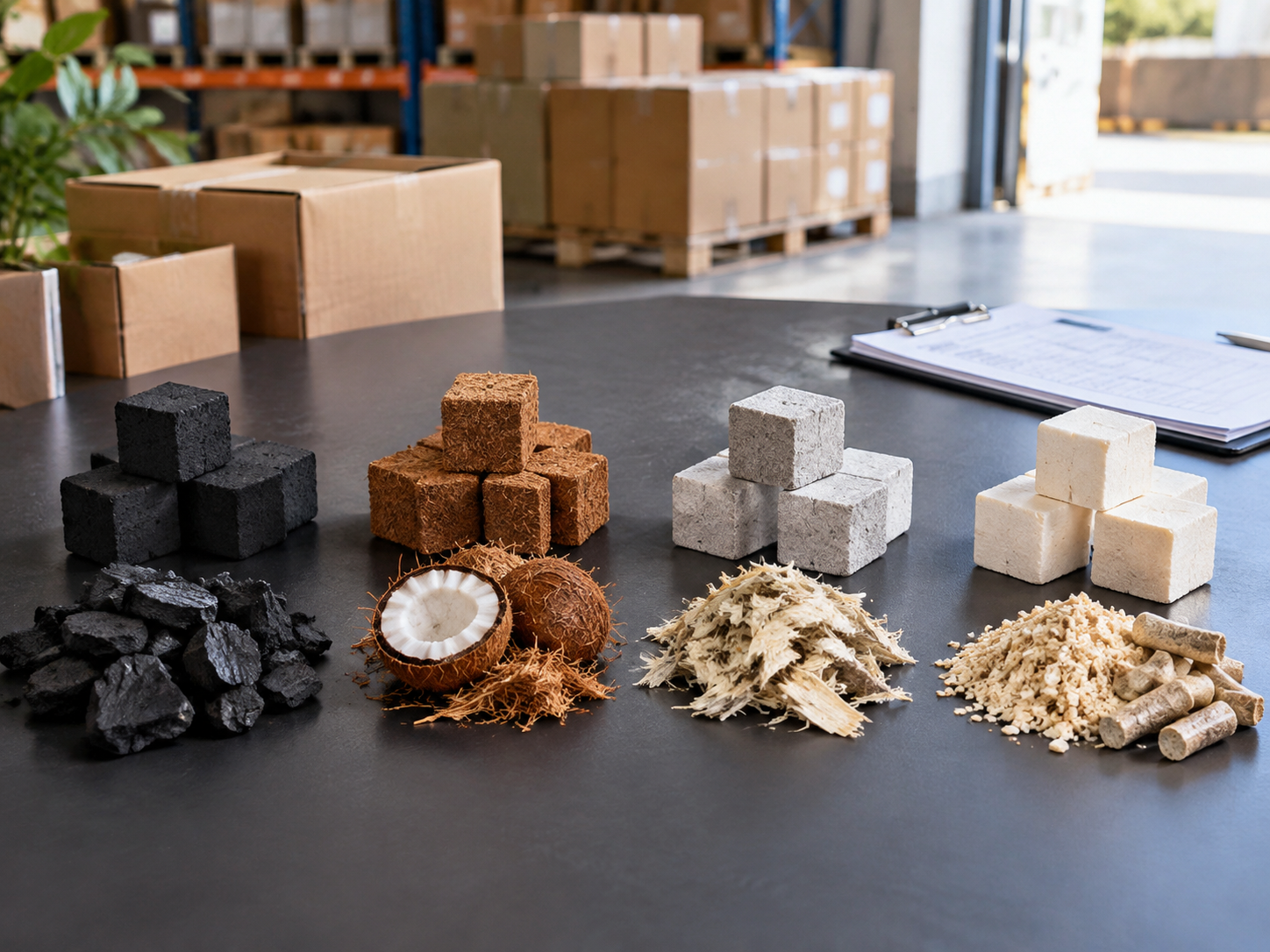
2025 Hookah Charcoal Market Outlook: Why Importers Are Diversifying Beyond Coconut Shell Charcoal
Importers are reassessing hookah charcoal sourcing as supply disruptions, changing logistics costs, product consistency, and demand for variety make single-source strategies riskier. The article outlines a practical approach to comparing coconut shell charcoal with alternatives such as bamboo, fruit wood, and quick-light products, emphasizing documented specifications, supply reliability, compliance, and safe handling.

How to Evaluate Alternatives to Coconut Shell Charcoal: A 7-Step Importer Checklist
Switching charcoal feedstocks can affect heat, ash, odor, breakage, delivery reliability, and brand reputation—not just purchase price. This checklist helps importers define product requirements and compare shisha, quick-light, and alternative charcoal under consistent conditions, while keeping incense charcoal specifications separate.